Composer, conductor, and teacher
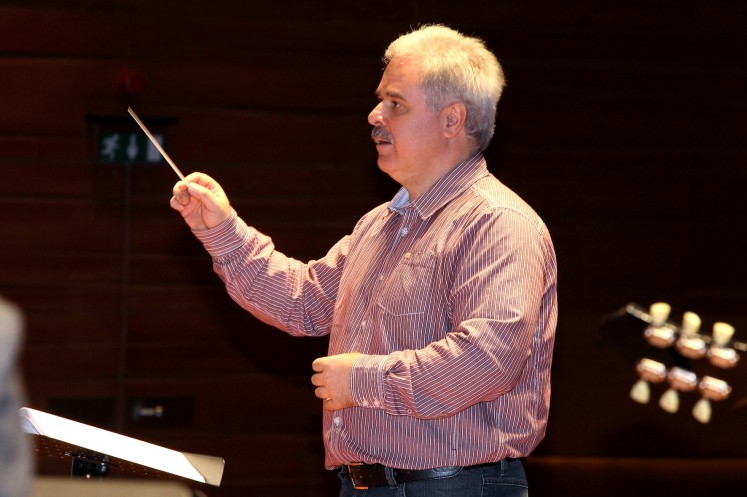
Born in Pécs, Hungary, Tamás Schóber completed all his studies in his beloved hometown. In 1986 he graduated from the Janus Pannonius University with a degree in Music and Cultural Education, while simultaneously completing his brass instrument teaching studies. (UNIV TV link)
He later earned an advanced conductor’s diploma in Budapest under István Párkai, and pursued composition studies with Tibor Stark. In 2005, he passed his pedagogical specialization exam at the Budapest University of Technology and Economics (BME).
His recordings have achieved significant success, and the Association of Hungarian Record Publishers has honored his work with gold and platinum records. In 2011, an independent documentary film about his life was produced, directed by János Szilágyi, editor-in-chief, which led to his inclusion among Hungary’s prominent personalities. In 2014, he earned the Master Teacher Qualification.
As a composer, he was invited to present his works at EUROPA CANTAT 2015, where, out of 56 participating countries, Hungary was among the five chosen for a live composer’s showcase. His live presentation was a great success, and his scores, publications, and recordings were distributed to 14 countries by music professionals, conductors, and managers. His works generated exceptional international interest.
In 2015, he was invited to Carnegie Hall, New York, where his composition Missa Mosso and his choir were featured in performance. That same year, he initiated a civil movement to found a musical association aimed at preserving the traditions of Hungarian choral art. He became the founding president and artistic director of the Pannon Children’s Choir, established under the Pannon Music Association in autumn 2015. The choir, known as the PTE Pannon Children’s Choir, received notable patronage and support from Mrs. Zoltán Kodály, among others.
In 2016, another invitation came from New York—this time addressed both to Tamás Schóber and the Pannon Children’s Choir. Numerous concerts and recordings followed, enriching the cultural and musical life of Pécs. The carefully planned American tour took place between June 16–27, 2017, culminating in their performance at Carnegie Hall.
From January 2018, Schóber was engaged by Manhattan Concert Productions (MCP), participating in a variety of Broadway and concert productions until 2022.
Between July 10 and August 2, 2019, the PTE Pannon Children’s Choir embarked on a Canada–USA concert tour, centered around the International Choral Festival in Missoula, Montana, with additional performances in Calgary, Vancouver, San Francisco, Los Angeles, Cleveland, and New Brunswick. They performed exclusively Hungarian choral music, including Schóber’s own compositions, to outstanding acclaim.
In January 2020, they were invited to Japan to perform at the Sing’n Pray International Festival and Competition in Kobe, where they earned a Bronze X distinction, returning home as prizewinners. Their competition repertoire included Schóber’s own works. The choir also held independent concerts and workshops in Tokyo, Kobe, and Osaka, where they promoted Zoltán Kodály’s world-renowned teaching philosophy, assisting Japanese choirs with performance interpretation.
Schóber has collaborated with numerous nationally and internationally acclaimed artists and ensembles, including Ghymes, Tamás Szarka, Fecó Balázs, Vilmos Szabadi, Attila Nyerges, Béla Szakcsi Lakatos, Szekszárd Big Band, István Pecze, Imre Antal, Sándor Szakácsi, Piroska Molnár, László Helyei, Györgyi Lang, János Kulka, Éva Vári, Menyhért Szegvári, András Lovasi, András Berecz, István Csukás, Géza Pécsi, Andrea Szulák, Boldizsár László, Gabi Tóth, Jennifer Mága, Attila Kökény, Kati Wolf, Nikolas Takács, László Kovács, Andrea Rost, Zoltán Mága, and others. He has also shared the stage with world-famous conductor Ken-Ichiro Kobayashi and violinist Zoltán Mága.
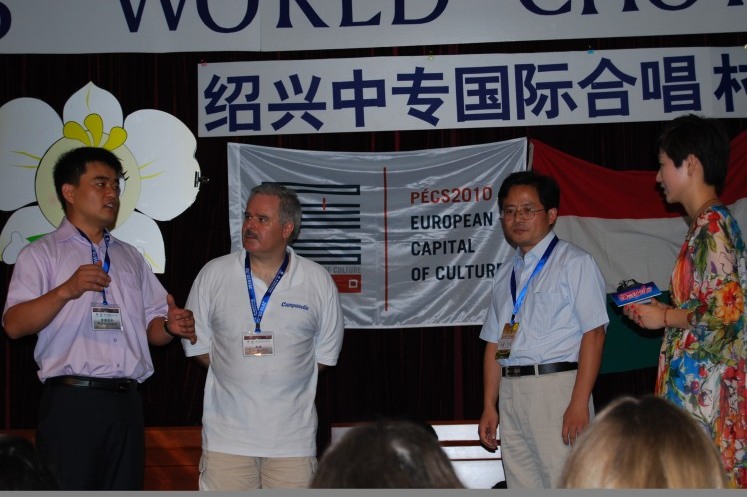
His choirs have earned award-winning performances at international competitions such as the World Choir Games (China) and have served as ambassador choirs for Europa Cantat. Alongside his conducting work, Schóber has gained international recognition as a composer, with performances in Shanghai, Beijing, Calgary, Vancouver, Missoula, San Francisco, Los Angeles, Cleveland, New Jersey, New York, Tokyo, Kyoto, Osaka, and Kobe.
His compositions have reached audiences not only in Hungary but across Europe and worldwide—including China, Canada, the USA, and Japan—through both live concerts and digital distribution. Between 2018 and 2022, online downloads and streams of his works surpassed several hundred million.
Since 2015, Schóber has maintained close contact with the artistic management of Carnegie Hall and Manhattan Concert Productions, with plans to feature his own works in future concerts. Following an initial world premiere in 2022, further performances were scheduled at Carnegie Hall in 2023.
During the pandemic, Schóber devoted increasing time to composition, making it the central focus of his creative life. With the PTE Pannon Children’s Choir, he undertook several world tours, premiering his own works globally. His compositions have since premiered in New York, New Brunswick, Tokyo, and other international cities.
In his free time, he enjoys spending time with his family, walking in nature, and working on his estate.
From summer 2022, Schóber ended his 44-year career as a conductor, dedicating himself fully to composition.
Since 2023, he has devoted his life exclusively to composing, practicing his art freely, without any institutional constraints or obligations.
In spring 2024, during a successful South American tour, he promoted Zoltán Kodály’s educational philosophy in Colombia, Peru, and Argentina.
Another trip followed in the fall of 2025. This time he made a fruitful and successful visit to Singapore, New Zealand and Australia as the leader of the Pannon Music and Cultural Project of the World Hungarian Network Program. His work as a composer, conductor and teacher is also becoming increasingly well-known in these parts of the world!
The name Schober appeared in medieval Germany, particularly in Bavaria and around Salzburg, as early as the 13th century.
The word “schober” means “haystack” and originally referred to people working in agriculture or living near such structures. Later, the name became associated with teachers, cantors, and clerks in southern Germany.
Earliest known mentions:
Leutolt der Schober – 1289, Hohenstein (Bavaria)
14th–17th centuries: multiple Schober family members were recorded as cantors and schoolmasters in Salzburg, Passau, Linz, and Regensburg.
Possible early ancestors:
[Schober ancestor] (★~1220 – ✝~1290) – Bavaria, farmer, local community member
[Schober Branch A] (★~1250 – ✝~1320) – Salzburg / Passau area, church worker
[Schober Branch B] (★~1320 – ✝~1390) – early schoolmaster and cantor
[Schober Branch C] (★~1450 – ✝~1600) – clerk, organist, parish musician
[Schober Branch D] (★~1650 – ✝~1750) – Upper Austria / Regensburg region, cantor
→ In the late 18th century, one branch of the family migrated to Hungary via Austria, likely through ecclesiastical or musical service.
↓
⭐ Franz Adolph Friedrich Schober (★1796 – ✝1882)
Vienna – poet, friend of Franz Schubert; a key cultural figure in the Schober heritage.
⭐ Josef Schober (★1841 – ✝1917)
Gödre, Hungary – cantor, composer; possibly the link between the Bavarian–Austrian and the Hungarian Schóberbranches.
Historical note:
According to local records, one of Josef Schober’s children or nephews was likely János Schober / Schóber, a music teacher and harmonium player in Abaliget around the turn of the 19th–20th centuries. This corresponds chronologically with János Schóber Sr. (★1904 – ✝1984), suggesting a probable shared lineage.
↓
⭐ János Schóber Sr. (★1904.02.23 – ✝1984.04.12)
Abaliget, Baranya County – singer, violinist, accordionist
♡ Erzsébet Simon (★1912.05.05 – ✝2000.01.29)
Siblings (side branches):
András Schóber (elder brother)
→ Schóber István → Schóber Anna; Schóber József → Schóber Klára (★1962), Schóber Györgyi
Mátyás Schóber (younger brother)
→ Schóber Erzsébet, Schóber Gyula, Schóber Mária
↓
├── Ferenc Schóber (★1929.07.06 – ✝2003.08.14)
MÁV employee, accordionist
♡ Katalin Pernecker (★1926.04.20 – ✝2010.12.14)
↓
├── Julianna Schóber (★1954.01.18) → Ferenc Gulyás Jr. (★1978.02.23)
└── Ferenc Schóber Jr. (★1956.10.04) ♡ Gabriella Oroszlán (★1960.04.15 – ✝2003.10.23)
↓
├── Gabriella Schóber (★1985.11.14)
└── Gergely Schóber (★1989.08.08) ♡ Anita Dér (★1984.04.28)
↓
├── Márton Schóber (★2017.03.22)
└── Máté Schóber (★2021.01.27)
⭐ János Schóber (★1931.04.19 – ✝2020.02.05)
Pécs – conductor, music teacher (piano, clarinet)
♡ Teréz Füredi (née Flander, ★1931.12.25 – ✝1995.11.08), agronomist, administrator
↓
├── János Schóber Jr. (★1955.10.06) – physical education teacher, coach, pianist
│ ♡ Erzsébet Schvéd (–1990, divorced)
│ ├── Tímea Schóber (★1986.01.18) – marketing manager
│ └── András Schóber (★1988.08.04) – environmental engineer
│
└── ⭐ Tamás Zsolt Schóber (★1963.06.05)
Pécs – composer, conductor, music educator
♡ Márta Anikó Kozma (★1966.01.31) – mathematics, chemistry, and IT teacher
↓
├── Soma Schóber (★1995.02.19) – lawyer, composer (classical & jazz; trumpet, bass guitar)
└── Sára Schóber (★1996.11.30) – economist, plays guitar and piano
By the late 18th century, the Schober surname (also Schöber, Schoeber) was common in southern Bavaria and Upper Austria (Salzburg, Linz). Many family members served as teachers or church musicians.
Documented names (archival sources):
Matthäus Schober (~1750) – Salzburg schoolmaster
Johann Michael Schober (~1770–1830) – Regensburg cantor
Franz von Schober (1796–1882) – poet, friend of Franz Schubert, born in Malmö to a Bavarian family of Thuringian–Bavarian roots
From this musical-cultural lineage evolved the “musical Schober line,” which in the early 19th century migrated eastward through Austria to western Hungary (Buda, Pécs, Gödre).
Franz von Schober’s Viennese branch
His name appears in several 19th-century Hungarian records as “Schober” or “Schóber,” especially in Baranya and Tolna Counties.
The Gödre branch (Josef Schober)
In mid-19th century Gödre, Josef Schober (1841–1917) served as a cantor and composer. He is believed to have descended from the southern Bavarian Schober family, having arrived in Hungary through the church’s teaching network.
The Abaliget branch (János Schóber Sr.)
By the early 20th century, János Schóber Sr. (1904–1984), a Hungarian native, inherited the family’s musical and pedagogical traditions directly from the Gödre line. The family name now appeared in its Hungarianized form, “Schóber.”
The Schóber family has preserved a musical and educational legacy across multiple generations.
The name remains well-known in Baranya County and Pécs, where family members have contributed significantly to music, education, and culture.
From 13th-century Bavarian roots to 21st-century Hungarian artistic and intellectual achievement, the Schober / Schóber lineage embodies centuries of dedication to art, teaching, and community life.
The Tamás Schóber branch continues to uphold and expand this musical and spiritual heritage.


 amás
amás  chóberCreating with Pleasure